
Real estate is one of the most dependable ways of accumulating wealth in the US. Rental income, long-term gains, tax benefits, and portfolio diversification are all opportunities found in property investing that attract both new and experienced investors. Nonetheless, success in real estate hardly occurs in the absence of appropriate knowledge. This is why new investors are attending real estate investment training programs in increasing numbers.
Training courses are the starting point for making smart and confident investment choices for those who are just starting out. This blog discusses why property investment education is important, what new investors are likely to learn, and how guidance from professionals such as Ignite Re Wealth can help prevent costly mistakes and increase real estate investment success.
Why New Investors Are Drawn to Real Estate
Investing in real estate is one of the areas that appeals to new entrants due to its numerous benefits. Real estate is less volatile in the long term compared to stocks or other paper assets because it is tangible and easier to comprehend.
The most critical reasons new investors prefer real estate are:
- Opportunity to receive consistent rental income.
- Improvement of property value in the long run.
- High control in relation to other investments.
- Financing opportunities.
- Tax concessions, including depreciation.
Even with such benefits, there are also risks associated with real estate. What may appear to be a great investment can quickly turn into a financial burden when market shifts, unforeseen repair costs, legal obligations, and property damage transform the opportunity into an economic liability. That is why proper education is necessary at the initial stage.
The Importance of Real Estate Investment Training Courses
Real estate investment training programs aim to equip new investors with the skills and knowledge to navigate the property market successfully. Novice learners do not have to learn expensive lessons; they can benefit from organized education provided by expert professionals.
New investor training courses assist them in:
- Know various strategies of investing in real estate.
- Make correct and objective analyses of deals.
- Understand the basics of financing and mortgages.
- Manage federal, state, and local regulations.
- Manage risk and protect their investments.
An effective training program will convert abstract real estate ideas into a real action plan.
What New Investors Learn in Property Investment Courses
Quality real estate investment training programs are based on broad topics that are essential for long-term success.
Learning the Basics of the Market
The courses impart knowledge on how to study local markets, analyzing supply and demand and identifying areas with growth potential. New investors are informed about how trends in employment, population growth, and interest rates affect property values.
Investment Strategies
Novices are exposed to popular strategies like buy-and-hold rentals, fix-and-flip projects, short-term rentals, multifamily investments, and commercial real estate. Knowledge of these strategies will assist investors in determining which of the approaches would be more appropriate to their financial objectives and level of risk tolerance.
Financing and Leverage
Education on mortgages helps investors understand how mortgages work, why there is a difference between a traditional mortgage and an FHA mortgage, and how to arrange deals with leverage in a responsible manner.
Legal and Compliance Knowledge
Real estate laws are state- and municipality-based. Training in landlord-tenant laws, fair housing requirements, zoning laws, and tax requirements is usually taught. These legal points help investors avoid costly violations and conflicts.
Property Management Basics
New investors are taught how to screen tenants, charge rental prices, maintain properties, and deal with lease contracts. These fundamentals are useful even to those who plan to employ property managers.
Risk Management and the Role of Property Damage Awareness
Property damage risk is one of the areas that beginners tend to underrate. Water damage, fire, storms, vandalism, or structural issues are among the issues that can greatly impact the rental income and property value.
Real estate investment training programs that work should focus on the following:
- The use of a proper inspection of the property.
- Obtaining the correct insurance cover.
- Learning the insurance claims process.
- How to respond during property damage events.
This is where specialists such as Ignite Re Wealth become especially valuable. Their experience assists investors in navigating complex insurance claims, ensuring repairs are properly managed and financial losses are minimized. For new investors, the way to respond to property damage can be the difference between a short delay and a significant financial loss.
How Training Courses Help Avoid Costly Mistakes
The failure of many new investors is not due to unprofitable real estate business but rather to lack of education. Some typical beginner mistakes include paying more than required for properties, underestimating the renovation costs, specific location selection, or ignorance of the law.
Training programs on real estate investment facilitate the avoidance of such problems by ensuring:
- Deal analysis frameworks
- Due diligence checklists
- Real-world case studies
- Instructions on how to deal with agents, lenders, and contractors.
By learning from the mistakes of veteran investors, new investors can avoid repeating errors that tend to cause the property portfolios to decline in the early stages.
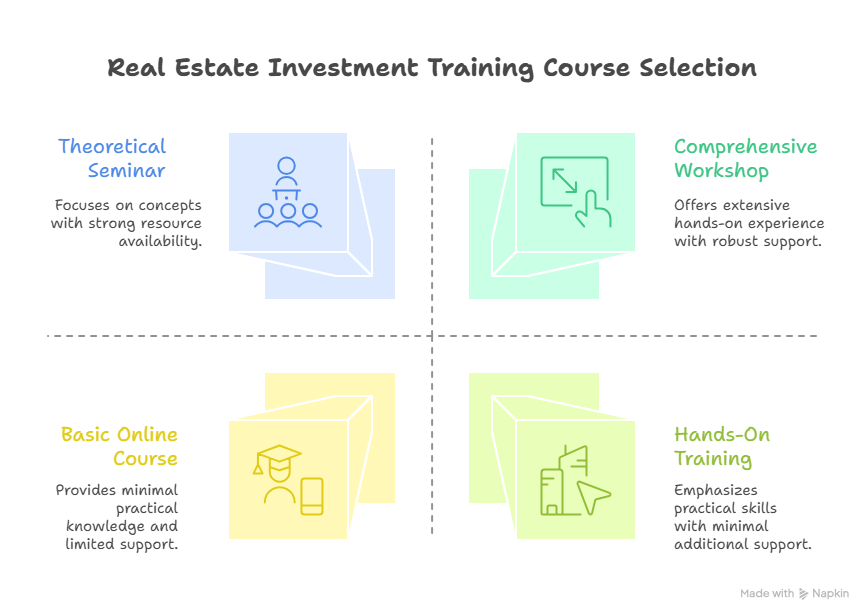
Choosing the Right Real Estate Investment Training Course
With so many options available, it is very important to choose the right training course.
Seek Real-World Practical Content
Focus on courses that are not theory-based. The greatest programs have real-life examples, tools, and processes.
U.S.-Specific Education
Make sure that the course is centered around the American laws of real estate, the way of financing, and the tax structure since this is quite different in other countries.
Experienced Instructors
The courses offered by active investors or practitioners in the industry can provide more practical knowledge in comparison to academic courses.
Continuous Support and Resources
Mentorship, community access, and follow-up learning materials provide long-term value beyond the initial course.
Realistic Expectations
Watch out for programs that promise fast wealth. Patience, planning, and informed decision-making are the keys to sustainable success in real estate.
Online vs. In-Person Training Courses
New investors have the option of taking online or in-person real estate investment training.
Online Courses
These are flexible and convenient, allowing investors to learn at their own pace. They are also cheaper and more convenient for people who have both work and family commitments.
In-Person Courses
Major workshops and seminars are offered live, where participants can interact directly with instructors and other investors. In particular, networking opportunities and real-time feedback can be of great use.
A combination of the two formats is used by many successful investors to generate knowledge and contacts.
Building Confidence Through Education
The key advantage of real estate investment training is confidence. Through appropriate education, new investors are in a better position to analyze opportunities, make business deals, and communicate effectively with other professional groups like lenders, lawyers, and contractors.
Knowing how to cope with the challenges, such as the property damages and insurance claims, with the help of Ignite Re Wealth will provide investors with peace of mind and enhance their decision-making in the long run.
Long-Term Benefits of Real Estate Investment Education
Investment in real estate is not a short-term process but a long-term plan. Training sessions assist investors in establishing systems that support long-term portfolio growth. Educated investors are more flexible; they have a better ability to see opportunities and protect the already existing assets.
With continuous learning and strategy optimization, investors can grow their portfolios while managing risk.