There are certain words people say to us that we never forget. Sometimes they become wounds. Sometimes they become warnings. And sometimes, if we let them, they become fuel.
For me, those words came during one of the most difficult and important transitions of my life.
I had made the decision to leave my position at the church where I had been serving. It was not a careless decision, and it was not one I made overnight. At the time, I was a single mother raising triplet boys, which meant every choice I made carried the weight of four lives, not just one. I had responsibilities, bills, children depending on me, and a future that felt both uncertain and full of possibility.
When I went to tell my boss I was leaving, I expected the conversation to be emotional. I knew there might be disappointment, questions, and concern. What I did not expect was to be told that I would fail.
I was also told I was selfish for leaving, especially as a single mom to three boys. Those words landed hard.
There is something deeply painful about being told your desire to build a different life is selfish, particularly when the entire reason you are trying to build that life is that you want more for your children. I was not trying to abandon responsibility. I was trying to create a future that looked different from the one I had known.
But in that moment, someone else was defining my decision through their own lens. To them, leaving meant risk. It meant uncertainty. It meant I was stepping outside of what they believed was safe.
To me, staying had begun to feel like a different kind of risk.
I knew there was more in me. I knew I had gifts, ideas, strength, and a desire to build something of my own. I did not know exactly what the road ahead would look like, but I knew I could not continue living only according to what made other people comfortable.
There is no better motivator than someone telling you that you will fail.
Fear Does Not Always Sound Like Fear
One of the things I have learned over the years is that fear can disguise itself as wisdom.
It can sound practical. It can sound responsible. It can even sound loving.
People may tell you that you should be grateful for what you have, that you should not take chances, or that this is not the right time. They may remind you of your responsibilities and point out everything that could go wrong. Sometimes those concerns come from a sincere place, but even sincere concern can still keep you stuck.
I had to decide whether I would allow someone else’s fear to become the boundary around my life.
That decision was not easy. As a single mother, I did not have the luxury of pretending there were no risks. I knew there were. I understood what was at stake. But I also understood that staying in a place where I no longer belonged would come with a cost of its own.
There is a difference between being reckless and being willing to take a calculated step toward a better future.
I did not leave with every answer. I did not have a perfect plan, complete confidence, or a promise that everything would work out. What I had was a deep belief that I was capable of building something more.
Sometimes that is enough to begin.
I Did Not Become Successful Overnight
Looking back now, it would be easy to make the story sound neat and predictable. I could tell you that I left, found my path, and everything worked out exactly as planned.
That is not what happened.
I made mistakes. I struggled. I learned lessons the hard way. I questioned decisions and worried about whether I was doing the right thing. There were moments when the words spoken to me came back, and I wondered whether that prediction was going to come true.
Growth rarely looks impressive while you are in the middle of it.
It often looks like uncertainty, long hours, wrong turns, difficult conversations, and choices that other people do not understand. It looks like doing the next thing before you know how the entire story will unfold.
That is how I built my life and my business.
I took one step, then another. I learned what I needed to learn. I asked questions. I worked. I adjusted. I failed in some areas and succeeded in others, but I did not stop moving.
Eventually, that path led me into real estate and small multifamily investing.
From Being Told I Would Fail to Building a $32 Million Portfolio
Today, I own a real estate portfolio valued at more than $32 million, with a focus on small multifamily properties.
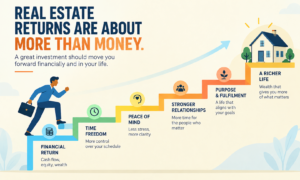
I share that number not because the story is only about money, but because it represents what can happen when you refuse to let someone else’s prediction become your identity.
The woman who was told she would fail did fail at times.
I bought properties that required more work than I expected. I dealt with management problems, renovation surprises, financing challenges, contractors who disappointed me, and decisions I wish I had made differently. There were moments when the numbers did not work the way they had on paper, and moments when owning real estate felt more like solving one problem after another.
But those failures did not make me a failure.
They made me experienced.
They taught me to ask better questions, build stronger teams, watch expenses, study the numbers, and take responsibility for the outcome. They taught me that success in real estate is not created by avoiding every mistake. It is created by learning quickly, adapting, and continuing to act.
That is an important distinction.
Many people believe successful investors somehow avoid fear, setbacks, and doubt. In reality, they often experience all of those things. The difference is that they do not let them become permanent.
That experience shapes the way I approach multifamily investing coaching today. I do not teach people to wait until fear disappears. I help them build the knowledge, judgment, and support they need to take responsible action while fear is still present.
The Biggest Mistake Investors Make
One of the reasons this story matters so much to me is because I see the same struggle in investors every day.
They want to buy multifamily real estate, but they are waiting for certainty.
They want to know the deal will work before they make the offer. They want to understand every number, every document, and every possible outcome. They worry that the broker will think they are inexperienced, that a partner will say no, or that they will make an expensive mistake.
So they keep learning.
They:
- Attend another seminar
- Watch another video
- Download another spreadsheet
- Spend more time reviewing deals
They call it preparation, but sometimes preparation has become a place to hide.
How Does Education Help New Multifamily Investors Take Action?
I believe in education. I believe in underwriting, due diligence, strong partnerships, and understanding the risk. But education should lead to action. It should help you move, not give you a more sophisticated reason to stay where you are.
Effective multifamily investing training should do more than provide information. It should help investors apply what they are learning to real properties, real conversations, and real decisions.
You do not become an investor because you know the language of real estate.
You become an investor by doing the work of one.
That means:
- Speaking with brokers
- Reviewing properties
- Building relationships
- Making offers
- Learning how to make decisions when you do not have every answer
How Do New Real Estate Investors Build Confidence?
Confidence usually comes after action, not before it.
A multifamily real estate mentor cannot remove every risk or make every decision for you. The right mentor can help you recognize when you are preparing wisely and when fear has simply found a more acceptable way to keep you from moving.
Why I Share This Story
I share the story of being told I would fail because I know I am not the only person who has been discouraged at the exact moment they were trying to grow.
Maybe someone told you your idea would not work. Maybe they reminded you of every reason you should stay where you are. Maybe they questioned your experience, your age, your finances, or your ability to succeed.
Maybe the person doubting you is not someone else.
Maybe it is you.
The voice inside your own head can be just as limiting as the voice of a boss, family member, teacher, or friend. It may tell you that you waited too long, that you missed your chance, or that other people are more prepared than you.
How Can You Overcome Self-Doubt as a New Investor?
You do not have to accept that voice as truth.
You can listen to wise counsel without handing over your future. You can evaluate risk without allowing fear to make every decision. You can acknowledge that the road may be difficult and still choose to walk it.
That is what I did. I did not leave because I knew I would never fail. I left because I knew failure was still better than never finding out what I was capable of building.
Take the Next Step
- You may not know exactly where your decision will lead. I did not.
- You may not feel completely prepared. I did not.
- You may be carrying responsibilities that make the decision harder. I was.
The question is not whether you can remove every risk before you begin. The question is whether you are willing to take the next responsible step toward the life you say you want.
What Is the Next Step for a New Multifamily Investor?
For one person, that step may be:
- Learning how to analyze a small multifamily property
- Calling a broker
- Touring a deal
- Finally submitting an offer
- Starting a business
- Leaving a job
- Making a decision that others do not understand
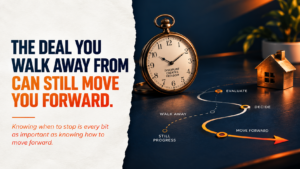
The step does not have to impress anyone. It just has to move you forward.
My life did not change because everyone believed in me.
It changed because I chose to believe there was more for me, even when someone in authority told me otherwise.
Years later, I can look back and see that moment differently. What felt like an insult became a challenge. What could have become a reason to stay small became the push I needed to prove that my future was not theirs to predict.
Today, I have built a portfolio worth more than $32 million, created a business, and helped other investors take steps they once believed were beyond them.
Not because I never failed. Because I kept going. The day I was told I would fail could have become the day I gave up on myself. Instead, it became the day I began proving what was possible.