By Cynthia Trammell
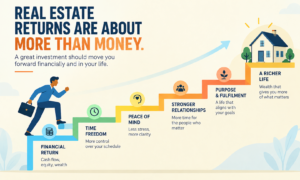
A property can make money and still be a bad investment for your life. That sentence would have bothered me earlier in my career. If the cash flow was there, the equity was growing, and the numbers worked, what else was there to talk about? Quite a bit, as it turns out. There is a return we calculate on almost every multifamily deal, and then there is another return we rarely put into the spreadsheet at all. The first one measures what the property gives you financially. The second measures what owning it requires from you. Time. Attention. Stress. Relationships. The number of decisions that keep following you home. I have become much more interested in both.
A Good Return Can Hide an Expensive Property
Suppose two properties produce similar income. One runs relatively smoothly. The management team communicates well, the residents are stable, major systems are in decent shape, and the ownership group makes decisions without turning every issue into a battle. The other property produces the same amount of money. Except you are constantly chasing information. Every renovation seems to uncover another problem. Partner conversations take twice as long as they should. Management needs repeated direction, and there is always one more issue waiting when the current one is finally solved. On paper, those returns may look nearly identical. Your life would tell you otherwise. That does not mean difficult properties should never be purchased. Some of my best lessons have come from solving hard problems. But there is a difference between taking on difficulty because the opportunity justifies it and collecting difficulty as though being exhausted proves you are a serious investor. I am no longer impressed by complexity for its own sake.
Your Time Belongs in the Underwriting Too
We calculate renovation budgets down to the dollar. We estimate insurance, taxes, management fees, vacancy, repairs, and utilities. Yet owners rarely ask what the business plan will require from them personally. Maybe we should. A heavy value-add property can produce tremendous upside, but somebody has to lead the work. A poorly performing management company may technically be inexpensive while costing the owner hours every week. Even a partnership structure can become expensive when every decision requires six phone calls and three different interpretations of what everyone originally agreed to. There is no line on the operating statement called owner frustration. That does not make it free. This is one reason experience changes real estate deal analysis. Early on, you are trying to determine whether the numbers work. Later, you start asking whether you actually want to own the business those numbers represent. That is a better question.
I Want My Properties to Need Me Less Over Time
I expect a new acquisition to require attention. There is usually a transition period. You are learning the property, building the team, correcting problems, implementing the business plan, and discovering which assumptions survived closing. That is normal. What I do not want is for year three to require the same intensity as month three. Something should be improving. The systems should become stronger. Management ought to understand the expectations. Recurring problems should either be solved or have a clear process around them. My role should gradually move away from putting out fires and toward watching performance and making higher-level decisions. Otherwise, I did not build an investment. I may have purchased myself another job. And that is not why I got into real estate.
This Is Where More Doors Can Become the Wrong Scoreboard
Real estate loves unit count. People introduce themselves by how many doors they own. I understand why. It is simple, visible, and easy to compare. It can also tell you almost nothing about the life behind the portfolio. Someone with 200 units may have built a beautiful business. Another investor could own 30 units that produce meaningful income, carry manageable debt, have excellent partners, and require very little of their personal time. Which one is winning? I cannot answer that without knowing what each person wants real estate to create. That is why I continue to believe in Small Multifamily Investing. Not because small is automatically better. Because the right smaller properties can produce meaningful wealth without requiring every investor to build a huge company just to support the portfolio. There is a point where growth adds freedom. There can also be a point where growth starts consuming it. Knowing the difference matters.
Some Problems Are Worth Solving
I do not want this mistaken for an argument that everything should be easy. Real estate is a business. Buildings break. Residents move. Markets change. A lender can surprise you, contractors can disappoint you, and occasionally a property will have a season where it needs far more attention than you expected. That comes with ownership. The issue is not whether a property ever causes stress. I am looking at whether the stress is creating something worth having. A difficult renovation that materially increases income and value may be absolutely worth six hard months. Spending three years repeatedly fixing the same operational failure is different. One creates value. The other creates a pattern. Good Multifamily Investing Coaching should help investors learn to recognize that distinction, because the answer is not always sitting in a cell on the underwriting model. Sometimes judgment means knowing which problems deserve your energy.
Freedom Has an Operating Side
We talk about financial freedom as though it is purely a money equation. Earn enough passive income, and eventually you are free. I think that definition is incomplete. What good is replacing your paycheck if the assets that replaced it now own your calendar? There should be an operating side to freedom too. Can you leave town without wondering whether the property will survive the week? Do you have people who can make decisions when you are unavailable? Does every small problem require your involvement, or have you built enough structure that most of them never reach you? Those questions matter to me now. I want income. I also want control over my time. If I have to choose between slightly more money and dramatically more life, I am at least going to have that conversation.
The Return I Care About Has Gotten Bigger
I still look at cash flow. I still care about equity, debt, expenses, and what the property can become. None of that has changed. What has changed is the size of the equation. Today, I also care about the people I will own the asset with, the management required to operate it, the complexity of the business plan, and whether the property moves me toward the life I am building or quietly pulls me away from it. Because wealth is not simply having more assets. It is having assets that make more of your life available to you. There will always be another property to buy and another opportunity to grow. The harder discipline may be knowing when enough complexity is enough. I do not want to reach the end of a successful real estate career with a portfolio full of assets and discover that I traded away the very thing I was trying to buy back. My time.